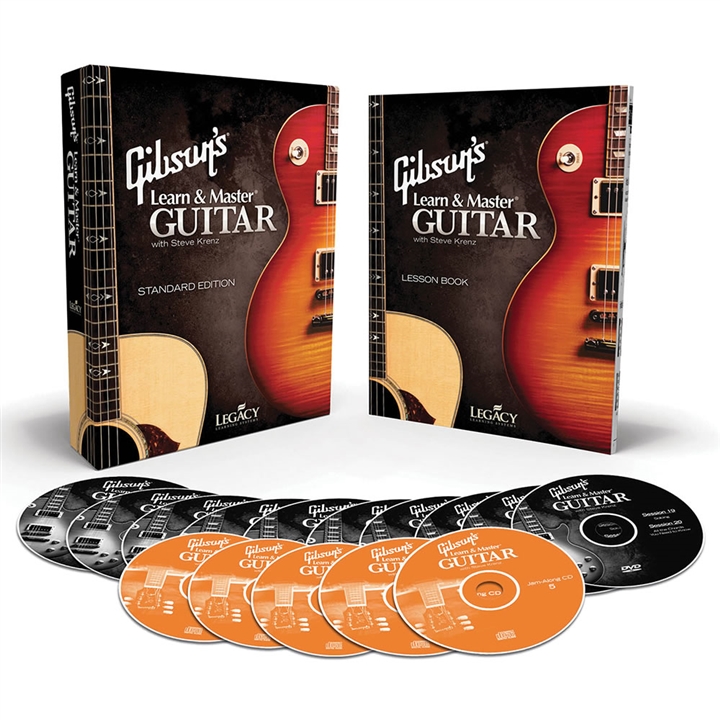
The Music Industry Praises Legacy Learning Systems Award-Winning Learn & Master Series

Monday June 29, 2009

Legacy Learning Systems Learn & Master Series, an award-winning series of comprehensive courses in guitar, piano, drum and ballroom dance instruction, has the music industry buzzing. “I can think of no better comprehensive, instructive tool for budding songwriters than Legacy Learning Systems Learn & Master series,” says ASCAP Assistant VP Herky Williams. “The program is also great for professional musicians striving to be their best and improve their game."

Legacy Learning Systems produces truly comprehensive multimedia training courses, bringing personal dreams within reach for its consumers. Legacy’s programs have received several honors including a Telly Award for Excellence in Education, Acoustic Guitar Magazine’s Player’s Choice Award, an AEGIS Award and a Pegasus Award in the Education category. Founded in 2005 by entrepreneur Gabriel Smith, Legacy Learning Systems currently offers educational courses on guitar, drum, piano and ballroom dance with photography and painting to be unveiled later this year.

“We started getting a lot of inquiries from songwriters that were looking to excel their abilities,” says Gabriel Smith, CEO and founder of Legacy Learning Systems. “We are excited at the recent acknowledgement from recording industry organizations and successful leaders in the songwriting and grassroots music fields. We hope to become the go-to series for songwriters and artists across all genres that are looking for a program to further their musical abilities.”

Every Learn & Master program enables customers to teach themselves within the comfort of their own homes and most importantly at their own pace. “As a songwriter for many years, I have discovered the importance of knowing how to play an instrument,” says Sandy Mason, songwriter on Garth Brooks’ #1 Two Pina Coladas and Crystal Gayle’s When I Dream. “After viewing the videos and reading the book that’s included in the Learn & Master Guitar course, I quickly learned that this is a must for any artist or songwriter. I would highly recommend this product. It’s first class.”

“As instructive programs this gets the gold ribbon!” says SESAC Executive VP Dennis Lord. “This is as good, no better than being face to face with a live teacher because it's 24/7. Steve Krenz is so engaging, non threatening and easy to follow.”

The Legacy Learning team has developed programs that not only work for the individual, but find placements in home and public school systems. “We are living in an age of declining art and music in schools,” says Michael Johnathon folksinger, creator, producer and host of WoodSongs Old Time Radio Hour. “We are being introduced to the first generation in human history that absorbs music and art almost exclusively as a two-dimensional experience. It is all ear buds, iPods, computers, car speakers and flat screen TVs. Yet, music and art remain one of the most passionate needs of people lost in this two-dimensional world. Legacy Learning Systems is the key that can open that door for families nationwide and for generations to come.”

Posted in Gibsons Learn and Master Guitar , Learn and Master Painting , Learn and Master Piano | Make a Comment

Chord Substitution Tricks of the Pros (Part 2) - Minor 11th Chords

Monday June 29, 2009

One of the things that I have found most helpful in my professional playing career has been the use of a few simple chord substitution tricks. In my previous blog, I mentioned a key one for major chords - You can substitute a Major 2 chord for any Major chord to create a modern and open sound. Here’s one that works for minor chords.

In most playing situations, you can substitute a Minor 11th chord for any Minor chord to add richness and color to your sound.

For example, here is a typical chord progression in the key of C. The first line is what would be written on the page but with some chord substitution tricks I would play the second line giving it a much more interesting sound.

Remember, you can substitute Major 2 chords for Major chords and Minor 11th chords for Minor chords.

Keep Learning and Growing!
Steve Krenz Author - Learn and Master Guitar

Posted in Expert Help | Make a Comment

Chord Substitution Tricks of the Pros (Part 1) - 2 Chords

Wednesday June 24, 2009

One of the things that I have found most helpful in my professional playing career has been the use of a few simple chord substitution tricks. I’ll focus on one of them here.

In most every playing situation, you can substitute a Major 2 chord for any Major chord to create a modern and open sound.

For example, if the chord progression is D to G to A then I would play a D2 to a G2 to an A2. You can substitute them anywhere you see a regular major chord. So, the next time you see a C chord, try putting in a C2 instead!

Keep Learning and Growing!
Steve Krenz
Author - Learn and Master Guitar

Posted in Expert Help | Make a Comment (3)

Guide To Fingerpicking

Friday June 19, 2009

Fingerpicking style when playing guitar is almost imperative to learn. If you want to play classical style, or just play without strumming hard, fingerpicking is a great tool to learn. There are lessons on the Learn and Master Guitar that demonstrate the proper way to fingerpick, and how that corresponds to music tabs. This is just a sample of the fingerpicking lessons that come with the Learn and Master Guitar DVD series.

Posted in Expert Help | Make a Comment (2)

The Secret to Barre Chords - Lower Your Wrist

Monday June 15, 2009

Barre chords are often one of the biggest hurdles that most players face as they are learning how to play guitar. Most of the time folks just can’t quite get enough pressure against the string and fret and they end up with notes that sound “buzzy” or muted. Mastering barre chords is a game of focusing the right amount of pressure to get a clear sound.

I have taught thousands of people how to play barre chords effectively and here are some ideas for you to think about.

Squeezing the guitar neck doesn’t work. You can squeeze your guitar neck until the varnish begs for mercy and you probably aren’t going to get that F chord to ring out clearly. The answer is not in your “squeezing” muscles of the hand.

The strength needed for barre chords comes from the index finger. Keep your index finger straight--straight as an arrow. The index finger is where the strength for the barre comes from. Don’t let that index finger bend back, keep the pressure on.

Lower the wrist. Resist the urge to raise your thumb and wrist up the back of the neck of the guitar. I know it seems like this is the only way to get enough pressure, but actually it is fooling you and won’t get the job done. When playing barre chords, lower your wrist, keep your first finger straight and apply pressure back on to the fret board.

It takes time to develop the muscles needed for barre chords.Many folks just give up on barre chords too soon.  Developing the muscles enough to play barre chords effectively takes time--weeks or months usually. Don’t get discouraged after three days of trying with little results. You might be doing nothing wrong and it just needs to take a bit more time to see the breakthrough.

I hope this helps. Thanks for letting me be a part of your learning process.

Keep Learning and Growing!
Steve Krenz
Author - Learn and Master Guitar

Posted in Expert Help | Make a Comment (2)